
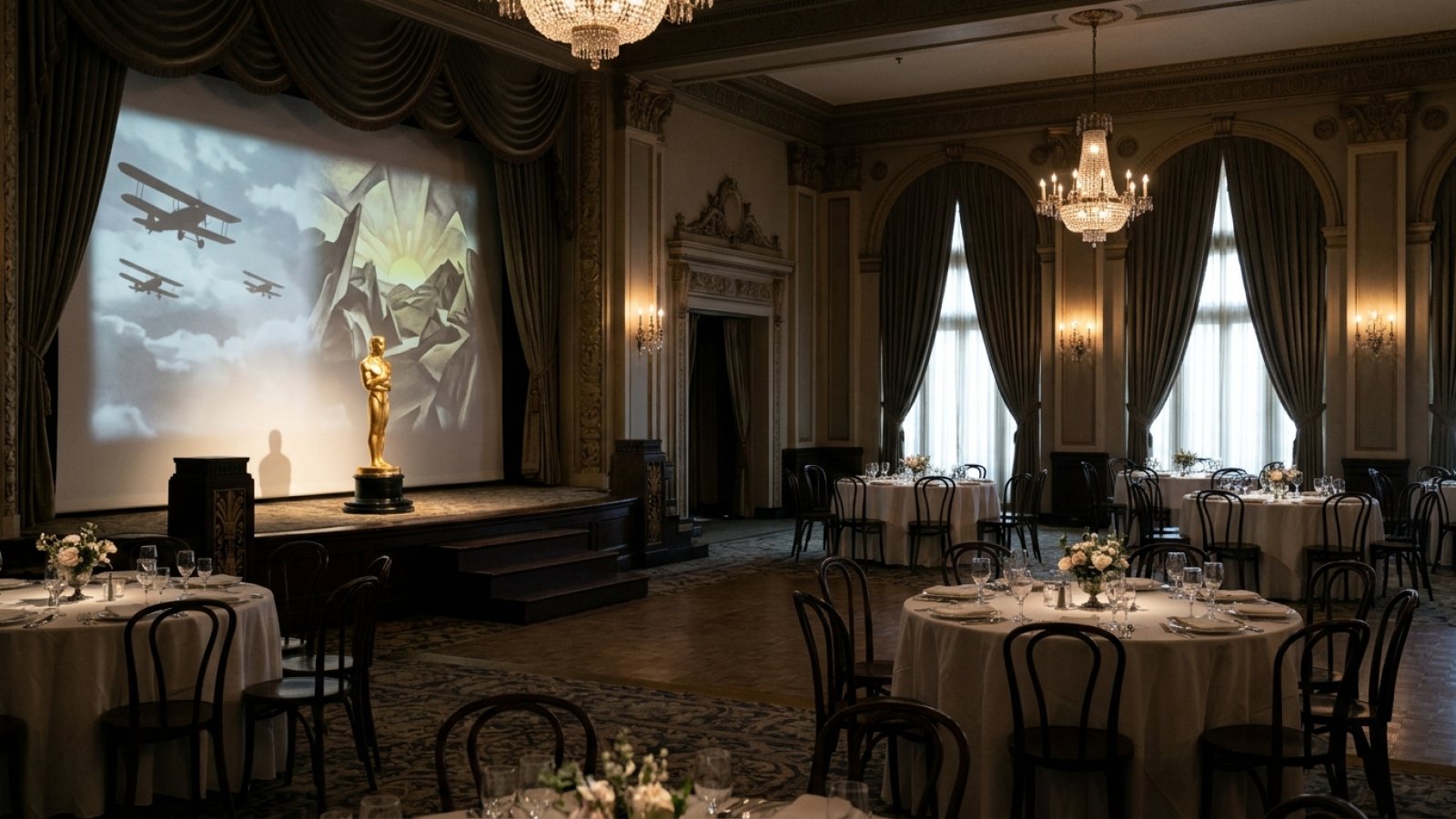
Wings, Sunrise, and May 16, 1929: The Quiet Dawn of the Academy Awards
On May 16, 1929, a small banquet in Hollywood quietly launched what would become the world's most prestigious film awards. This inaugural ceremony honored films like Wings and Sunrise, laying the groundwork for cinema's enduring institution.
On May 16, 1929, at a private banquet in the Blossom Room of the Hollywood Roosevelt Hotel, a quiet revolution began. Before the red carpet spectacle, before global broadcasts, before the sealed envelopes and the breathless anticipation, the very first Academy Awards were presented. This humble gathering, attended by a mere 270 people who paid five dollars for their tickets, marked the official recognition of cinema as an art form worthy of its own accolades, establishing a tradition that would eventually shape the industry’s self-perception and global audience engagement. That night, two vastly different films, the soaring aviation epic Wings and the poetic visual masterpiece Sunrise: A Song of Two Humans, stood as the pioneering recipients of cinema’s highest honors.
The Quiet Inauguration
The Academy of Motion Picture Arts and Sciences (AMPAS) had been formed in 1927, an initiative by Louis B. Mayer to mediate labor disputes and promote industry image. The awards were conceived as a way to honor excellence, but their initial rollout was decidedly low-key. Winners for the ceremony held in 1929, recognizing films released between August 1, 1927, and July 31, 1928, were actually known three months in advance, leaked to the press, stripping the event of any dramatic tension. Douglas Fairbanks, the Academy’s first president, presented the statuettes himself, a stark contrast to the parade of celebrity presenters we know today.
Among the eleven categories, two stood out as the top prizes for films: “Outstanding Picture” and “Unique and Artistic Picture.” The former went to Paramount’s Wings, a spectacular World War I aviation drama that captivated audiences with its aerial dogfights and human story. The latter, acknowledging a more experimental vision, was awarded to F.W. Murnau’s German Expressionist marvel, Sunrise: A Song of Two Humans. Individual acting honors went to Janet Gaynor for her performances in 7th Heaven, Street Angel, and Sunrise, and to Emil Jannings for his work in The Last Command and The Way of All Flesh. Frank Borzage received Best Director (Dramatic Picture) for 7th Heaven, while Murnau was honored for Best Director (Comedy Picture) for Sunrise. This early split in directing categories, alongside the dual best picture awards, revealed a nascent industry’s struggle to define cinematic excellence across its diverse output.
Art, Spectacle, and the Screen's Divide
The choice of Wings and Sunrise for the top film honors perfectly encapsulated the dual aspirations of early cinema: blockbuster entertainment and high art. Wings, directed by William A. Wellman, was a technological marvel for its time, employing revolutionary aerial photography and large-scale practical effects. Its immense popularity demonstrated cinema's power to draw vast audiences and offer thrilling, immersive experiences. The film's success at the box office, particularly in the domestic market, cemented its status as an industry triumph, proving that epic storytelling could also be incredibly profitable. It was a testament to the spectacle side of the screen, reaching the audience on an emotional, visceral level.
In stark contrast, Sunrise: A Song of Two Humans, a silent film by German master F.W. Murnau, was lauded for its audacious visual storytelling and profound emotional depth. This triumph of German Expressionism brought sophisticated European artistry to Hollywood, pushing the boundaries of what a film could convey without spoken dialogue. Murnau’s innovative camera work and symbolic use of light and shadow set new standards for cinematic craft, profoundly influencing generations of filmmakers. Its win for Unique and Artistic Picture underscored the Academy's initial ambition to celebrate not just commercial success, but also groundbreaking artistic achievement, recognizing that film, at its best, was a profound and evolving art form.
A Legacy Takes Flight
The distinction between "Outstanding Picture" and "Unique and Artistic Picture" was short-lived, with the latter category disappearing after this first ceremony. This consolidation hinted at a future where popular appeal and artistic merit would largely converge into a single “Best Picture” ideal. Yet, the very existence of these two awards for that initial year speaks volumes about the early days of cinema – an art form grappling with its identity, balancing mass appeal with aesthetic innovation. The 1929 ceremony, though lacking the grandeur that would soon define it, planted a crucial seed. It legitimized film as a serious cultural endeavor, providing a benchmark for excellence that the industry would aspire to year after year.
From that quiet banquet, a global phenomenon grew, transforming the Academy Awards into the ultimate arbiter of cinematic prestige, influencing careers, shaping box office narratives, and drawing the eyes of the world to the power of the moving image. What began as an industry dinner evolved into a cultural touchstone, a yearly reflection of both the art being made and the audience it sought to captivate. The modest proceedings of May 16, 1929, truly marked the dawn of an institution that would forever connect the art of filmmaking with the public's imagination.
