
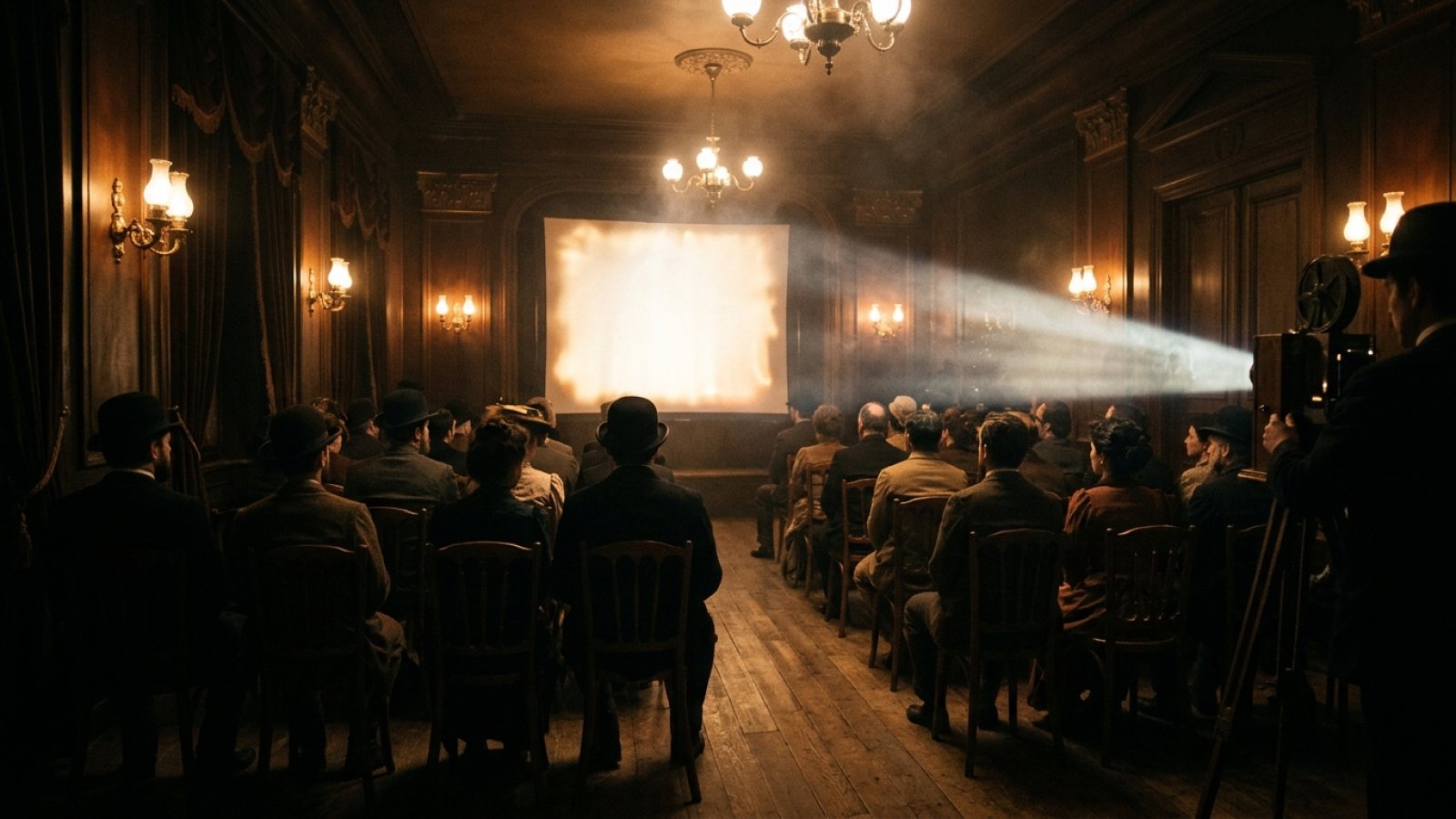
The Grand Café, 1895: The Night Cinema Found Its Paying Audience
On a cold December night in Paris, a small, curious crowd paid a single franc to witness a miracle. It was the birth of cinema as we know it, transitioning from scientific novelty to a shared, paying spectacle.
On December 28, 1895, in the basement Salon Indien of the Grand Café in Paris, a new world flickered into being. While moving pictures had existed in various forms, from peep-show Kinetoscopes to private scientific demonstrations, this night marked a pivotal moment. For the first time, a paying audience gathered not out of scientific curiosity, but out of a simple desire to be entertained by the impossible made real. This seemingly small event, a mere twenty-minute program of short films, fundamentally changed how people spent their leisure time and laid the foundation for an art form that would sweep the globe.
The Invention, The Novelty, The Show
Brothers Louis and Auguste Lumière, manufacturers of photographic equipment, had developed the Cinématographe: a single device capable of recording, printing, and projecting moving images. Its crucial innovation was the ability to project onto a large screen, making a communal viewing experience possible. Unlike Thomas Edison’s Kinetoscope, which confined its moving images to individual viewers peering into a box, the Lumières' invention invited a shared experience, much like a theatrical performance. Their first public paid screening featured ten short films, each less than a minute long, documenting everyday life. These included the iconic La Sortie de l'usine Lumière à Lyon (Workers Leaving the Lumière Factory), a simple but profound observation of daily routine.
The initial audience was small, reportedly just 33 people, each paying one franc. But word of mouth spread quickly. Within weeks, queues formed outside the Grand Café, eager to witness what was then called 'animated photographs.' Other titles shown that evening included L'Arroseur arrosé (The Sprinkler Sprinkled), considered the first true comedy film, showcasing the power of sequential images to tell a simple, humorous narrative. This direct connection between the images on screen and the laughter or gasps from the audience immediately demonstrated the medium's powerful grip.
A New Form of Art and Experience
What unfolded at the Grand Café was not just a technical demonstration; it was the birth of cinema as an immersive, collective experience. The shared darkness, the flickering light, the gasp from the person next to you – these elements created a new ritual for the audience. The films themselves, while seemingly mundane, were revolutionary. L'Arrivée d'un train en gare de La Ciotat (Arrival of a Train at La Ciotat Station), for instance, was not just a recording; it captured perspective, movement, and an inherent dramatic tension that captivated viewers. The often-debated legend of audiences fleeing in terror from the onrushing train, while likely exaggerated, speaks to the visceral impact these early moving images had on people accustomed only to still photographs or stage plays.
This was where the very craft of the shot began. The Lumières, often called documentarians, instinctively understood framing and composition, transforming everyday reality into compelling spectacle. The simple act of observing people at work or a train pulling into a station became an event, highlighting the artistic potential of capturing and presenting movement. This initial exploration of realism would soon blossom into more complex narratives, shaping the language of visual storytelling for generations to come. The silent witness of the camera became a potent tool for both art and entertainment.
The Seeds of an Industry
The success at the Grand Café ignited a global phenomenon. Within months, the Lumière brothers sent cinematographers across the world, projecting films and documenting life in new locales. Rival inventors and entrepreneurs quickly emerged, developing their own cameras and projectors, leading to a scramble for innovation and audience. This single night in Paris provided the blueprint for an entirely new industry: one that would require dedicated venues, distribution networks, and eventually, the massive studio systems that would define the Golden Age of Hollywood. The transition from a small Parisian café to opulent picture palaces across continents was swift and profound.
That evening, the Lumières did not just project images; they projected the future. They cemented the concept that moving pictures were a viable, exciting form of public entertainment, laying the groundwork for the global cultural force that cinema remains today. The ripple effect from that modest gathering ultimately shaped everything from how stories are told to how billions spend their Friday nights, forever linking the Grand Café to the grand narrative of film history.
