
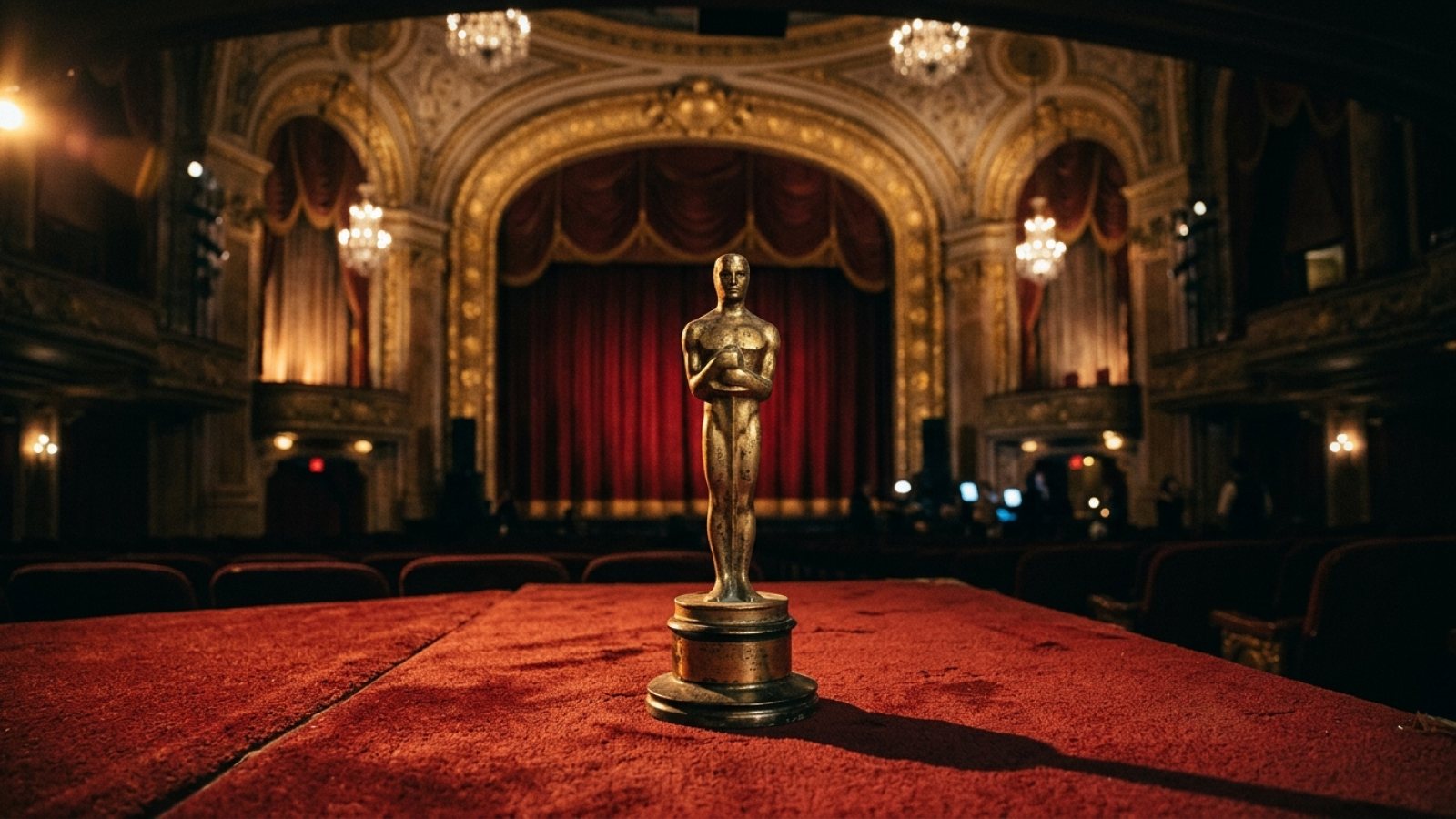
Citizen Kane at the Oscars: The Film That Lost Best Picture and Won the Century
In 1942, a groundbreaking film arrived at the Academy Awards, polarizing the industry and ultimately losing the top prize. Yet, despite its modest win, _Citizen Kane_ would go on to reshape cinema and earn its place as a perennial masterpiece.
When the Academy of Motion Picture Arts and Sciences gathered for its 14th annual ceremony in February 1942, Hollywood was abuzz with a sense of its own grandeur and the looming shadow of war. Among the films vying for the top honors was a picture so audacious, so unlike anything seen before, that it stood as both a marvel and a lightning rod: Orson Welles’s directorial debut, Citizen Kane. It arrived with nine nominations, a testament to its technical and artistic ambition, yet left with only a single award. This moment on the timeline, marking the Academy’s judgment of the films of 1941, reveals a striking contrast between contemporary industry reception and cinema’s eventual canonization, underscoring that critical acclaim and public adoration can sometimes be a slow burn, not an immediate blaze.
The Battle of 1941
The year 1941 offered a strong field of contenders for the industry’s highest accolades, but few stirred as much controversy as Citizen Kane. From its release, the film faced an unprecedented campaign of sabotage, largely fueled by newspaper mogul William Randolph Hearst, who saw the fictional Charles Foster Kane as a thinly veiled and unflattering portrait of himself. This powerful opposition not only crippled the film’s box office performance, preventing many potential audience members from ever seeing it in its initial run, but also created a palpable chill within Hollywood.
As the ceremony held in 1942 approached, the nine nominations for Citizen Kane — including Outstanding Motion Picture, Best Director for Welles, Best Actor for Welles, and Best Original Screenplay — hinted at its undeniable artistic merit. Yet, the industry’s resistance to Welles, a young outsider from the Mercury Theatre, combined with Hearst’s powerful influence, created a hostile environment for the film. When the final envelopes were opened, the most prestigious award, Outstanding Motion Picture, went to John Ford’s poignant drama, How Green Was My Valley. It was a well-made, beloved film, but time would cast it in a different light when compared to Welles's revolutionary work.
A Single Golden Knight
Despite the backlash, Citizen Kane did not leave the ceremony entirely empty-handed. Its single, hard-won victory was for Best Original Screenplay, an award shared by Orson Welles and Herman J. Mankiewicz. This recognition acknowledged the film's intricate narrative structure, its sharp dialogue, and its bold, non-linear approach to storytelling, which presented the life of Charles Foster Kane through multiple, often conflicting, perspectives.
The screenplay was, indeed, foundational to the film’s revolutionary nature, but it was Welles’s holistic vision that truly transformed cinema. The film’s innovations extended far beyond the script: the unprecedented use of deep-focus cinematography, allowing multiple planes of action to remain sharp simultaneously; its expressionistic lighting and complex camera movements; the groundbreaking sound design, employing overlapping dialogue and intricate audio montages. These elements, though perhaps not fully appreciated by Academy voters at the time, were nothing short of a seismic shift in the art of filmmaking. The film was, first and foremost, a triumph of visual and sonic craft, challenging audiences and filmmakers alike to reconsider the very language of the medium.
The Slow Climb to Legend
For decades after its release, Citizen Kane remained an important, if often hard-to-see, film. Its initial commercial failure and the subsequent legal battles over its rights meant that wide audiences did not immediately embrace it. However, a crucial shift began in the 1950s and 60s. European critics, particularly those associated with the French New Wave, championed the film, recognizing its profound influence on modern cinematic grammar. Directors like François Truffaut and Jean-Luc Godard openly acknowledged its impact, inspiring a new generation of filmmakers to experiment with narrative and visual techniques. American critics, too, slowly caught up, rediscovering and re-evaluating Welles's masterpiece.
By the 1970s, Citizen Kane was firmly cemented in the pantheon of cinema. Major critical polls consistently ranked it as one of the greatest films ever made, if not the greatest. Its enduring influence is clear in countless films that followed, from its narrative complexity to its visual bravado. The Academy’s verdict in 1942, influenced by industry politics and personal animosity, reflected a momentary truth. History, however, has a longer view, and the audience of future filmmakers and discerning viewers ultimately crowned Citizen Kane not just a film of the year, but a film for the ages, demonstrating that artistic legacy often transcends the accolades of its time.
